

FOOD FOR THOUGHTS

Can prioritizing your aspirations influence the world?
My friends and teammates can testify, I am a demanding person. l often struggle with prioritization as I want to do EVERYTHING all at once, and in the BEST way possible (i.e. “perfectly”…). I often say the priority is A, B … and C and D because, let’s face it, everything is connected, urgent, and IMPORTANT. Even if this approach allows me to stretch myself and leverage systemic connections between different areas of my life, it sometimes feels overwhelming.
Have you ever felt you are juggling too many things at the same time?
Here are insights and tools to find inner peace while bringing a positive impact on the world.
My friends and teammates can testify, I am a demanding person. l often struggle with prioritization as I want to do EVERYTHING all at once, and in the BEST way possible (i.e. “perfectly”…). I often say the priority is A, B … and C and D because, let’s face it, everything is connected, urgent, and IMPORTANT. Even if this approach allows me to stretch myself and leverage systemic connections between different areas of my life, it sometimes feels overwhelming.
Have you ever felt you are juggling too many things at the same time?
If so, trust me, it may take time for you to be the changemaker you want to be while preserving your inner ecology and peacefulness.
If not, lucky you ;). You can keep reading to find ways to help your close ones who are experiencing difficulties in prioritizing.
MY JOURNEY - AS A CASE STUDY
As I embarked on my journey to becoming a certified professional coach; I was leading two missions within my company and - little did I know - I was on the edge of facing personal and professional consequences from a worldwide, viral epidemic. I was full of self-doubt, and yet, super excited, ready to juggle both worlds, even if it meant waking up at 5.30 AM.
In 2020, I faced more than enough challenges for the little human that I am.
As a manager, I faced the unexpected departure of teammates, as well as the difficulty of reassuring and motivating a remote, multicultural team. I had to be agile enough to adjust, maintain and enrich our projects so as to turn this uncertain period into an opportunity for sustainability. Together, we launched a podcast for ecological change-makers, organized external stakeholders committees for our management to assess the business risks and priorities for action, and accompanied operational teams in key projects such as the launch of sustainable waste collection centers for informal waste pickers.
I navigated between a sense of flow and an imposter syndrome while learning the coaching techniques, testing them on clients, and building my blog (you may be able to imagine the challenge if I tell you I still type with a few fingers on my computer…).
As it is with many expatriates, I had to cope with the emotional stress of being prohibited from traveling back to my home country. That being said, I must admit that my situation in Japan was more acceptable compared to other friends in more restrictive countries.
Worst of all, I was battling against myself. I was torn between gratefulness for my network’s trust (or what I tend to perceive as optimistic gullibility), pride in my team’s dedication, anxiety related to the state of our world, and finally, guilt from ‘not doing enough. What I mean is I was not doing enough to help the world compared to my company’s workers who were removing the waste in the streets, or the doctors, nurses, and humanitarian workers who were saving lives.
All of that to say, I was pretty much struggling with my “I want to do it all” and “don’t complain” syndromes, until one day, I discovered the balance wheel exercise! Spoiler alert, this is not a magic wand.., although this is not far from it. This exercise is very powerful to map your priorities while balancing all important areas of your life.
Thanks to my usage of the tool, I progressively became clearer on what was really important for me and my missions. I realized that the less centered I was, the more tired and confused I became, and the less helpful I was to others. So now, whenever I feel overwhelmed, I use this tool to recenter my attention to my deep aspirations. I can then leverage my values, talents, and wonderful allies to create a virtuous cycle of positive actions. This allows me to move - in a smooth way - despite the unsettling flow of external circumstances.
***
actualizing your change
A SIMPLE Tool
First, ask yourself what are the important factors that would allow you to live a harmonious life?
Draw a wheel. Divide it into 8 categories and add your ideas in any order you want.
Then, without too much further deliberation, write down your level of satisfaction related to each item (the external line representing a 10/10 level of satisfaction).
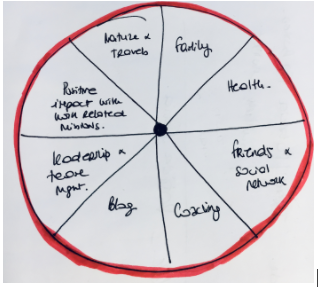
Illustration with the key topics at stake in 2020
Looking at your wheel, what does that tell you?
If you could improve one element that would boost your whole level of satisfaction,
What would you focus on?
What specific action - within your control and in harmony with the rest of your priorities - could you take?
Let's suppose you progressed on this item, what would be your next priority?
***
A MANTRA
““All men think that happiness is found at the top of the mountain, whereas it lies in the way of climbing it. “ ”
Over to you
What do you need to prioritize today, to find inner peace and yet be helpful?
Feel free to share how such an article resonates with you, I’d love to know. Besides, if you want support to become the leader you want for the world you expect, contact me! Here is a form find to further elaborate your ambition and challenges: English / French

Sommes-nous libres de choisir le chemin de notre vie?
Avez-vous déjà eu la sensation d'être coincé(e) dans votre vie? En tant qu'occidentale, j'ai été élevée avec le mantra «quand tu veux, tu peux». Bien qu'attirante, je trouve la théorie du libre arbitre un peu trop simpliste et oppressante pour certains individus. Découvorns quel est le vrai pouvoir de décision des individus!
Le Cheminement de pensée
Avez-vous déjà eu la sensation d'être coincé(e) ou frustré(e) dans votre vie? Personnellement, j’ai eu la chance de vivre de belles expériences mais je me suis souvent prise à rêver d’habiter sur une île grecque, travaillant à distance sur les sujets de mon choix et à mon propre rythme.
En tant qu'occidentale, j'ai été élevée avec le mantra «quand tu veux, tu peux». Pensons aux milliers de décisions que nous prenons chaque jour. Nous sommes les seuls à décider de sauter hors du lit ou de repousser l'alarme, de prendre une douche ou un bain, de devenir végétarien, flexitarien ou mangeur de viande. Chaque jour, nous prenons des milliers de décisions. Ceci étant dit, bien qu'attirante, je trouve la théorie du libre arbitre un peu trop simpliste et oppressante pour certains individus.
Quel est NOTre vrai pouvoir de décision?
Être libre implique l'absence de contraintes extérieures pour faire ou dire ce que vous voulez. Par exemple, j'ai décidé d'éviter de manger de la viande et de réduire ma consommation de poisson car je voulais me concentrer sur ce qui était en mon contrôle, en matière de lutte contre le changement climatique, tout en honorant mes valeurs de responsabilité et de citoyenneté.
Pourtant, certaines personnes me diront que j’ai été influencée par mes amis, mes lectures et mon travail dans ce choix. On peut effectivement se demander si nos actions sont plus influencées par notre écosystème que par notre simple pouvoir rationnel. Par exemple, malgré les preuves scientifiques, certaines personnes continuent de penser que les humains ne sont pas responsables du changement climatique.
Quelle est la part d’influence des causes externes dans notre prise de décision?
De nombreux penseurs ont démontré que les événements sont en fait déterminés par causes précédemment existantes. Le sociologue Durkheim a expliqué que nos idées, nos pensées, nos habitudes et nos actions sont fortement influencées par le contexte socio-économique dans lequel nous vivons.
Selon cette logique, je ne serais pas qui je suis - certaines personnes diraient une «bobo» bénéficiant d'une carrière internationale - sans les antécédents sociaux, valeurs et le réseau de ma famille, entre autres facteurs.
Je suis sûre que mes racines ont eu une forte influence sur mes conditions de vie actuelle. Pourtant, tout est-il déjà préconçu? Sommes-nous aveugles ou naïfs dans nos choix?
Et si la voie VERS la liberté dépendait de notre pouvoir de perception?
Plutôt que de considérer les humains comme des automates ou comme des personnes toutes puissantes, Freud a introduit une troisième façon de penser avec ses concepts du «moi», «ça» et «surmoi». Ces agents en interaction, représentant notre conscient, inconscient et subconscient, sont nourris par notre écosystème, nos normes sociales, nos pensées intérieures, nos pulsions et nos désirs. Fondamentalement, nous sommes confrontés à plusieurs sources d'influences, intrinsèques ou extrinsèques, en vivant nos vies.
Pour faire (très) simple, grâce à la psychanalyse, nous pouvons prendre acte de notre pouvoir et de notre responsabilité en rendant nos schémas de pensée inconscients, conscients. Ce faisant, nous pouvons nous libérer de nos croyances limitantes.
Accepter nos déterminants augmenterait-il notre liberté?
Avoir la volonté de reconnaître et de se détacher de nos déterminants, internes et externes, peut nous donner un certain contrôle pour construire notre avenir. Nous pouvons changer notre état d'esprit en ce qui concerne nos circonstances. Nous pouvons nous permettre d'imaginer l'avenir selon nos propres conditions et faire confiance à notre intuition. Oui, cela peut sembler épuisant. Personnellement, je n'y parviens pas toujours. Mais cela vaut le coup d'essayer car, quand cela fonctionne, le monde semble rayonner de lumière et de plaisir!
Pour le philosophe Descartes, on obtient la vraie liberté quand notre volonté et notre intelligence (capacité illimitée vs. capacité limitée) sont harmonieusement alignées. Ce postulat m’interroge. La liberté serait-elle une question d’équilibre? Un équilibre entre le fait d’accepter nos racines comme nos déterminants intérieurs tout en créant librement nos possibilités futures; un équilibre entre nos limites physiques et notre imagination illimitée, un équilibre entre nos attentes et notre confiance en l'inconnu. Un opposé nourrissant l’autre pour créer une fusion libératrice.
La voie du changement
L'OUTIL
Vous souhaitez être libre de choisir votre chemin de vie? Il peut être judicieux de commencer par comprendre vos moteurs profonds et vos potentiels blocages, puis d’aligner votre action avec vos attentes.
Plus facile à dire qu'à faire. Je sais! Voici une astuce pour vous aider à avancer: le jeu préféré (et revisité) des enfants… le jeu du «Pourquoi» ?!
Tout d'abord, considérez votre envie: “J’aimerais X”
Ensuite, creusez afin de chercher le besoin profond. Demandez-vous «qu'est-ce que X dit de ce qui est important pour moi? J’ai besoin de Y. Ok Qu’est ce que dit Y de ce qui est important pour moi? et ainsi de suite jusqu'à ce que rien de plus ne sorte.
Finalement, repartez de la source jusqu’au désir initial pour évaluer comment un tel besoin peut influencer votre comportement dans le futur.
L'ÉTUDE DE CAS
Prenons l'exemple d'une entrepreneure sociale désireuse de recruter des femmes au sein du conseil d'administration de son entité et confrontée à la résistance des fondateurs de l’entreprise. La conversation avec un coach pourrait ressembler à ceci:
Qu'est-ce que ce souhait de positionner des femmes au niveau du conseil d'administration dit de ce qui est important pour vous?
Eh bien, c'est évident: l'égalité. Et d’ailleurs, je suis en colère parce que clairement ce n'est pas reconnu et…
Ok concentrons-nous un peu sur cette notion si vous voulez bien. Qu'est-ce que l'égalité vous donne qui est encore plus important?
Eh bien, la reconnaissance du pouvoir de la diversité.
Et qu'est-ce que cette reconnaissance vous apporte qui est encore plus précieux?
Hum…l’acceptation de tous les êtres humains quels qu'ils soient. Rien n'est plus important que ça, vous ne croyez pas?
En étant pleinement accepté, qu’est ce qui change pour vous?
Je me reconnais et n'ai plus besoin de la reconnaissance externe. J'accueille ma différence et celle des autres comme un cadeau et comme un atout.
Et comment ce changement de perception vous aide-t-il dans votre projet de lobbying pour obtenir plus de femmes au sein du conseil d'administration?
Eh bien, les femmes ne devraient pas être représentées parce qu'elles sont des femmes. Nous avons simplement besoin de trouver différents acteurs qui enrichiront le débat et la décision au niveau du conseil. Donc des femmes, oui, mais pas n'importe qui et pas seulement les femmes. En fait, j'ai besoin de trouver les talents et les expériences qui nous manquent. Si les fondateurs comprennent la valeur d’avoir des personnes différentes dans notre start-up, nous ne devrions plus nous battre.
Le MANTRA
«Mieux vaut une erreur corrigée que pas d'erreur du tout»
Il vient du livre de Charles Pépin «Ceci n'est pas un manuel de philosophie» qui simplifie admirablement les concepts philosophiques sans endommager leur profondeur et leur signification.
À VOUS DE JOUER!
Quelle décision et expérimentation voulez-vous faire aujourd'hui?
***
Voulez-vous devenir le. la leader que vous souhaitez pour le monde que vous attendez ? Est-il temps de trouver et d’affirmer votre leadership ? Souhaitez - vous intégrer les enjeux d’impact positif et de raison d’être au coeur de votre organisation ? L’enjeu est -il d’accélérer l'engagement de votre écosystème pour créer un changement systémique ?
Si vous répondez par l’affirmative et si vous voulez être accompagné.e sur votre chemin, contactez-moi ! Voici un lien pour réserver un entretien d'exploration et le formulaire pour élaborer davantage votre ambition et vos défis.

Are you free to choose you life’s path?
Have you ever felt stuck in your life’s pattern? As I reflect on my life, I realize my path has been filled with intense and exciting experiences. Still, I have caught myself dreaming of living on a Greek island, working remotely on matters of my choosing and at my own pace. Have you had similar wishes?
As a westerner, I have been raised with the mantra “when you want, you can”. While attractive, I find the individual’s free will theory too simplistic and oppressive for some individuals. Let’s discover the real power of decision individuals have!
FINDING MEANING
Have you ever felt stuck in your life’s pattern? As I reflect on my life, I realize my path has been filled with intense and exciting experiences. Still, I have caught myself dreaming of living on a Greek island, working remotely on matters of my choosing and at my own pace. Have you had similar wishes?
As a westerner, I have been raised with the mantra “when you want, you can”. Let’s think about the thousands of decisions we make every day. We are the only ones to decide whether to jump out of bed or snooze the alarm for a bit, take a shower or a bath, become a vegetarian, a flexitarian, or a meat eater. Every day, we are the final decision-makers. While attractive, I find the individual’s free will theory too simplistic and oppressive for some individuals.
What range of power do individuals have when making their choices?
Being free implies the absence of external constraints so that you can do or say whatever you want. For example, I decided to avoid eating meat and drastically reduced my consumption of fish. Why? Because I wanted to focus on what was in my control when it came to the fight against climate change. Besides, I wanted to honor my values of responsibility and citizenship.
Yet, some people may say I was actually influenced by my friends, readings, or work in making such a choice. I cannot help but wonder: What if our actions were influenced by our ecosystem and our thoughts rather than influenced by facts? For example, despite the scientific evidence, some individuals believe that humans are not responsible for climate change.
Can external causes influence our decision-making ability?
Many authors have demonstrated that events are actually determined by previously existing causes. Sociologist Durkheim explained that our ideas, thoughts, habits, and actions are actually strongly influenced by the socio-economic context in which we live. I wouldn’t be who I am - some people would say a “bobo” enjoying an international career - without my family’s social backgrounds, values, and network, among other factors.
I am sure my roots have had a strong influence on my current life’s conditions. Yet, is everything pre-designed for us? Are we blind or naive when making choices?
What if our freedom depended on our power of perception?
Rather than considering Humans as automatons or omnipotent, Freud introduced a third-way of thinking with his concepts of the “ego”, “id”, and “superego”. These interacting agents, representing our conscious, unconscious, and subconscious brains, are nourished by our ecosystem, social norms, inner thoughts, impulses, and desires. Basically, we face several sources of influences, either intrinsic or extrinsic, when living our lives.
Through psychoanalysis, we understand our power and responsibility, is to turn our unconscious patterns of thinking into conscious patterns. By doing so, we can free ourselves from our limiting beliefs.
Would accepting our inner and outer determinants increase our freedom?
Having the willpower to acknowledge and detach ourselves from our determinants can give us control to build our future. We can change our mindset in regards to our circumstances. We can allow ourselves to imagine the future on our own terms. Yes, this may seem exhausting. I personally don’t always succeed in doing so. But it's worth trying!
For the philosopher Descartes, real freedom is obtained when our will and our intellect (unlimited vs. limited capacities) are harmoniously aligned. It makes me wonder: What if freedom was a question of balance? The balance between accepting our roots as our inner determinants while freely creating our future possibilities, the balance between our physical limitations and our unlimited imagination, the balance between our expectations and our trust in the unknown.
ACTUALIZING YOUR CHANGE
The tool
Do you want to gain back freedom in choosing your life path? Start by understanding your deep drivers and blockages. Then align your action with your expectations.
Easier said than done. I KNOW! Here are a few tricks to help you move the needle: the twisted four-year-old favorite Game of “Why”!
First, consider your wish: "I would like X".
Then keep digging for the root cause. Ask yourself “what does X tells me that is important?” You may find out you need Y. Repeat the question; “what does Y tells me that is important for me?” and so on until nothing more comes out.
Finally, go backward and assess how such a core driver affects your behavior.
The illustration
Let’s take the example of a social entrepreneur willing to get women at the board level and facing resistance from the founders. The conversation with a coach could go something like this:
The Coach: What does that wish for women at the board level says about you that is so important?
The Changemaker: Well, it’s obvious: equality. And I am mad because clearly this is not recognized and …
The Coach: Ok, let’s focus on that notion for a bit if you will. What does equality give you that is even more important?
The Changemaker: Well, the recognition of the power of diversity
The Coach: Oh, and what does this recognition brings you that is even more precious?
The Changemaker: Hum… acceptance of all human beings. Nothing is more important than this, don’t think?
The Coach: What’s the value of being accepted fully and completely?
The Changemaker: I recognize myself and don’t need external recognition anymore. I welcome my difference and one of the others as a gift and as an asset.
The Coach: And how does that change of perception help you with your project to lobby for more women at the board level?
The Changemaker: Well, Women should not be represented because they are women. We simply need to find different players that will enrich the debate and decision at the board level. So women yes but not anyone and not only women. I need to find the talents and experiences we are missing for. If the founders understand the value of such diverse people for our start-up, we should not fight anymore.
The Mantra
”Better an error-corrected than no error at all”
It comes from Charles Pepin’s book “Ceci n’est pas un manuel de philosophie” which beautifully simplifies philosophical concepts without damaging their depth and meaning.
Over to you:
What life experimentation do you want to start today?
***
What was useful to you in this article? Hit the reply or comment button and let me know! Besides, if you want support to find (or refine) your purpose and boost your impact on society and on the planet through professional activities, feel free to contact me using this form (English / French)

Three ways to avoid feeling powerless
Have you ever felt small and helpless in front of human pollution, natural and sanitary catastrophes, or social inequalities? Do you doubt we can be a changemaker, feel empowered and be authentically optimistic? One success factor lies in our mindset and our perception of reality. Here are 3 steps to overcome your fear of being powerless.
I was recently remembering with a friend how discouraged we were (and sometimes still are) when reading about human pollution, natural and sanitary catastrophes, social inequalities, or similar problems. Thinking of our world’s future can be quite depressing, so that sometimes we may lose hope and wonder about the meaning of our actions.
Sounds familiar? The good news is, you can be a changemaker, feel empowered and still be authentically optimistic. One success factor lies in our mindset and our perception of reality.
1. Acknowledge the reality
What resists, persists. Yes, this is hard to acknowledge how dysfunctional humans are. But acknowledging this fact does not mean validating this human and societal condition. When you only keep saying “it should not be this way” without taking constructive action, it’s a bit as if you were facing a house on fire and waiting for it to disappear without doing anything to change the situation. Chances are that if you quickly acknowledge the danger and call the fireman, the situation will be resolved rapidly.
Overcome your mirage. In “Loving what is”, Byron Katie applies “The Work” in allowing a person to accept their reality while answering those questions:
- Is it true?
- Can you absolutely know that it is true?
- How do you react when you believe this thought?
- Who would you be without this thought?
Finally, she asks the person to turn the thought around. Let’s take an example: The original thought of “I have no positive impact on the society” would become “my thoughts have no positive impact since they demotivate me to shift my way of living and working to bring a positive impact” or “ I have a positive impact if …”. In realizing this, you move from being a victim to being responsible for your interpretation of events and your reaction to them.
This approach may be criticized for its simplicity, especially in front of some complex issues. Yet, it may also help someone become conscious of their limiting thoughts and find “a way to change the projector - the mind - rather than the [thing] projected.”
2. Accept THE duality: YOUR limits and potential
Being part of the problem and the solution at the same time is acceptable. As the Eastern culture teaches us through the ying and the yang theory, forces that may seem opposite are actually deeply interconnected.
Just by buying food, we generate certain sources of pollution. Yet, we can also mitigate our impact on the planet by aiming for zero waste.
Act consciously in your own way. Yes, we are more or less all responsible for climate change. Yes, it is linked to a larger system of production and consumption. No, this is not a reason to wait for others to act first. If one simple individual cannot solve all the complex challenges of the world in one go, acting as a “Colibris” (Pierre Rabhi) may help you to realign with your values, make a positive impact and - who knows - create a collective shift towards a caring and responsible society.
3. Refine your strategy to maximize your impact
First, make sure you are clear on what’s really important for you and what’s relevant to your professional and personal activities. The issues of the world are endless. It is easy to feel overwhelmed just thinking about them.
To be useful, focus on your ambition and be pragmatic. You may want to distinguish between what you empathize WITH, and what you want to act upon. Then, decide how to proceed in real life while being aligned with your values and hopes for the world.
get inspired: a Case Study
Here is a story inspired by a real-life story. Our character's name is Sandra. She is a smart and committed woman who believes in the public sector’s leadership and the power of collective action. The problem is, she faces drastic budget restrictions and a seeming lack of motivation from her colleagues. She has thoughts like: “I am isolated, I am torn between my values and my day to day reality. It is hopeless. I can’t do anything. I can’t even succeed in making a simple positive change in my own institution."
To the question “is that true?” the answer is a direct and immediate “yes!”
To the question, “Can you absolutely know that it is true? What’s the evidence of it?” A long silence occurs. Then, “Well, I don’t know. At least, I am trying. I have launched different projects at work. I keep educating myself and I have reduced my waste at home.”
When asked about the opportunities for hope, she recalls the weak signals given by one or two colleagues. She has found potential allies!
When it comes to possibilities for action, the trio of women mingle, brainstorm alternative ideas, and come up with the idea of creating an urban farm. It’s a way to partner with local actors, grow eco-friendly products, and engage the staff.
They keep lobbying towards polite yet silent top management leaders. Still, the trio keeps planting some seeds. Eventually, some employees start sharing their wish for more commitment from upper management for their concerns, but they are afraid of potential consequences to their employment. From three persons, they become thirty. They organize collective debates outside working hours and collectively keep reinforcing their aims whenever possible.
One day, they receive a letter from the head of the institution announcing an innovation contest for “sustainable initiatives." They discovered the daughter of the director was their best ally. She had overheard him complaining to his wife about his inability to address his employees' requests. For three weeks his daughter kept asking him what he was doing to contribute to her future. One night, he remembered why he had joined the public sector, and it was to give power to the citizens. A day after, he wrote a letter about the contest!
activate your power
The best tools are often introspective questions that will trigger the most relevant and practical answers for you. Here are some that you may try to answer. Seat in a calm space, focus on yourself, take a deep breath (or two or three), and give it a try, even for one second per question. Listen to the immediate thoughts that come to you. You will be amazed by the strength of your mind.
What “fire(s)” do I want to put out?
If you struggle to answer such a direct question, you may want to break it down into manageable segments: What are the subjects that interest or affect you the most? Why so? What’s the real issue at stake? How does this relate to your daily life? The more clarity you have, the easier it will be.
What am I aiming for in focusing on such an issue?
Here you want to dream big. Answer questions like: What do I wish for instead? What would be the ideal scenario? What benefits would that generate and for whom?
How can I move forward?
This is the time for realistic planning. If you have no immediate answers, perhaps practical actions will be revealed if you ask yourself the following questions: "What is the first step I can take? Whom can I rely on? What resources will I activate? When do I commit to doing so?"
Over to you: Click on the button below to share your thoughts and comments with me!
““Forgive yourself for your faults and your mistakes and move on.””

WHAT IF Responsibility MEANT Impact AND freedom ?
Do you believe being responsible is either a burden or a price to pay for a mistake? Have you ever felt obliged to act in a certain way because "this was the right thing to do" or because you felt responsible for supporting someone? Would you like to feel responsible, free and happy at the same time? In this article, we will explore the ways to express our authenticity in a creative and meaningful way, both for you and others.
In our daily lives, being responsible is often seen as a burden or a price to pay for a mistake. “You are responsible for this mess.’’ “It is our responsibility to take care of the planet.” “This is not my responsibility but yours.”. Who has not felt stressed, angered, or even powerless when hearing similar statements?
Is having to be responsible so troublesome? Is there an alternative to either suffering from or ignoring our sense of responsibility?
FINDING MEANING
“where does our responsibility start and end”?
Originally, the notion of responsibility was positive. In Latin, “respondere” means “answer to, promise in return”. Basically, having the capacity to hold oneself accountable. What shall we be accountable for?
Shall we still be held responsible if the requests we face are unrealistic? When your boss asks you something impossible considering the resources at your disposal, should you try to turn the impossibility into a possibility?
Is it a person’s responsibility to take care of others’ irresponsibilities? For example, should Greta, a 15-year-old child, be responsible for fighting the climate change crisis created by previous generations?
The growing awareness of our human responsibility, for climate change and epidemics like the Covid19 pandemic, illustrates a shift in the people’s perception of their sense of responsibility. Whereas pre-industrial societies thought that natural catastrophes were caused by forces external to humans, modern society holds a different understanding.
If it is important to face reality, putting the job of changing human behaviors on the shoulders of individuals’ may be too overwhelming. Rather than being empowered, our reptilian brain tends to activate our “fight-or-flight” mode in front of such a monumental task. Could we see our responsibilities as a trigger for our expressing our humanity and sense of creativity?
FreeDOM to Determine our responsibility
We are neither omnipotent nor powerless. If we can't change the many circumstances of our world, we can change our perception of it, by tapping into our superpower called consciousness.
If we are conscious about what we think of a situation, we have the power to decide what we want to do about it. In doing so, we regain the ownership of our responsibility.
As Victor Hugo said, “everything that increases freedom also increases responsibility”. Yes, it is scarier to be accountable for our choices. But isn't it also exciting to see we have the power to act upon our environment and control its effect on our lives?
What impact do you want to HAVE?
When facing a situation, thinking about the reality you want to shape (rather than the effects or causes of that situation) may help you shift your mindset around the notion of responsibility.
Let’s escape from your rational brain for a second. Let’s imagine you’re diving in the Indian Ocean. You are enjoying being immersed in another dimension and being surrounded with nature. You’re peaceful… until you see a plastic bag on a coral reef.
Here, you have a few options:
You may think: “What a shame! Nature is getting destroyed! People are irresponsible!" You most likely feel pretty angry, ashamed or depressed.
You may decide to do nothing because, you have nowhere to put this bag, and there are so many other tragedies in the sea that it’s useless to take this singular action.
Alternatively, you may become enraged, pick it up and spend the rest of your dive being infuriated with human society.
Another way to think could be: “This is unfortunate and terrible for nature. We need to change the way we produce and consume on the land. In the meantime, since I saw it, I can pick it up even though it’s not convenient. It will at least be one less threat to fish.” Proud of your sense of responsibility, you enjoy the rest of your diving experience.
Some will say this reframing of the situation is positive psychology’s brainwash. Others will think that we will not save the planet by focusing on an individual’s small actions. Someone else may simply wonder what is the “right” attitude to have in this situation.
Honestly, this question is too complex for a simple singular answer. It’s up to you to decide what you want to think and do in relation to a given circumstance. Your impact depends on YOUR CHOICE.
actualizing your change
A SIMPLE TOOL
When facing either an obstacle, a fear or a rejection, what about taking a step back and asking yourself:
What are the facts?
What thoughts are generating a negative emotion within me?
What do I want to be like instead?
How may I act the way I want to feel?
Here is an example:
Facts: a business leader is explaining “sustainability is, at best, a cherry on the cake that shall be tackled only once the rest is taken care of and if time and resources allow”
Thoughts & emotions: “This is so wrong. With this kind of thought, our world will end pretty soon. I can’t work with people like that. I am feeling hopeless, exasperated & drained”
Ideal me: responding with empathy, trying to understand the real needs of the person and the smart ways to demonstrate sustainability’s added values
Aligned action (amongst many others): “do you feel overwhelmed and pressured with all business development & cost savings targets you are facing”? If yes, “what about discussing your challenges and seeing if we come up with some sustainable solutions?”
A MANTRA TO ACCOMPANY YOU
““If you own this story you get to write the ending.” ”
Now, back to YOU! How do you want to be responsible for your story today?
***
Feel free to share how such an article resonates with you, I’d love to know. Besides, if you want support to find (or refine) your purpose and boost your impact on society and on the planet through professional activities, feel free to contact me in using this form (English / French)

Can I be useful to others and self-loving at the same time?
Have you ever felt distorted between, the wish to be useful to others, and the need to secure your own well-being and to achieve your goals? Do you happen to have some difficulties deciding when to give, whom to give to and when to receive? If so, you are not alone! This short article will provide you with some insights and tools to feel balanced and impactful.
AN ENLIGHTENING STORY
(adapted from a real-life story)
Lana is a high achiever and corporate change-maker. Her most important driver in life is to be useful: useful to others, useful to projects, useful to good causes. Until recently, her identity was crafted around her capacity to always be there when someone needed advice, an ear to talk to, “a helping hand” when needed for a project. She was thrilled to be the go-to supporter who lightened up the lives of others.
As a superwoman, she kept organizing herself and multi-tasking to anticipate the needs of her close ones, colleagues, and even strangers. Yes, it was tiring, sometimes even alienating. Being everyone’s savior often implied forgetting her own needs and desires. But she did not see any other choices for herself. In her own words “this [was] the normal life of a dedicated, working woman.”
Together, we decrypted - without judgment - what “being useful” meant to Lana. We looked for the underlying beliefs that were nurturing such a consuming need for usefulness. As it turned out, the notion of utility was linked to her need for acceptance. To avoid rejection, she believed she had to be the perfect daughter, student, colleague, boss, friend, mentor, mother, and lover. Being perfect meant satisfying others.
In reality, she was turning herself into a “pleasing tool”, and it felt as if she could never fully please herself nor satisfy others. This was a vicious circle. One day, she realized she was giving to others out of a feeling of guilt and misery rather than love and selflessness. While advocating for the importance of self-love to others, she was the first one to reject any help or opportunities to take a well-deserved rest. She was lying to herself and others, and this had to stop.
If Lana was consciously eager to change, a part of her was resisting. Was she “allowed” to start prioritizing herself? Was she willing to take the risk of losing her sense of identity? Who would she become? She was terrified. It was as if she was on the bank of a river, desperately aiming to reach the other appealing side, but being afraid to cross what seemed to be a torrent of rushing water.
To tackle her recurring objections, we used a coaching tool called the “core outcome exercise”. Lana understood those mixed feelings were different parts of herself screaming to be heard. We listened, respectfully, to each positive message behind her feelings. She recalled her most important values in life: human accomplishment, freedom, and pleasure. To her, everyone who is fully aligned with themselves is able to develop their full potential to answer to the world’s needs. She used to think that her accomplishment depended on how useful she would be to persons who crossed her path. But in striving to please others, she lost sight of her own freedom and pleasure and lost herself and her ability to make her greatest impact. Instead of expressing her values, she was demonstrating an ineffective counter-model.
With that realization in mind, she revised her past, inner belief and created a more liberating thought. She created a morning routine and a decision-making tool that helped her to respect her own needs and to find the courage to choose whom and what to support. She turned her method of engagement upside down and started to lead by example. She demonstrated that being useful to others depended first on self-love.
THE TOOLS
Does this story sound familiar?
Do you want to be useful even though you still have some difficulties deciding when to give, whom to give to and when to receive? In wiling to be useful to others, are you afraid of being perceived as a fraud if you don't always put your beneficiaries' needs ahead of your own?
If so, you are not alone and you CAN find a balance!. Imagine you are a sponge. If you want to help clean surfaces, keep releasing the water you hold inside. Otherwise, you won’t be able to absorb any more water.
***
To help you to make a change, here are a few tips:
When starting your day (or while reading this article), ask yourself:
“How do I want to show up today?” You may say “peaceful, excited, or even confident”.
“In that regard, what are the 3 actions - 1 for myself, 1 for my private life, and 1 for my work - I want to take today?” If external requests start accumulating during the day, delegate and postpone tasks as needed to meet your priorities.
During the day:
Pay attention to your body’s signals. If you have a headache, cravings, or body tension, chances are you are controlling and resisting an inner need.
Go to a calm place (this can be the bathroom or even closing your eyes) and ask yourself: “what am I needing right now?” You may not be able to answer that need right away. Still, acknowledging your need, and planning some time to answer it, will help avoid an escalation of tension.
If someone insists and plays the emotional blackmail strategy, saying simply: “I hear you. Today is complicated. I’ll get back to you!” may do the trick. Put the request on a note to assess which strategy is best to deal with it, in the next few days (not today!)
***
And YOU, what is your level of balance between self-care and caring for others?
***
What was useful to you in this article? Hit the reply or comment button and let me know! Besides, if you want support to find (or refine) your purpose and boost your impact on society and on the planet through professional activities, feel free to contact me using this form (English / French)